




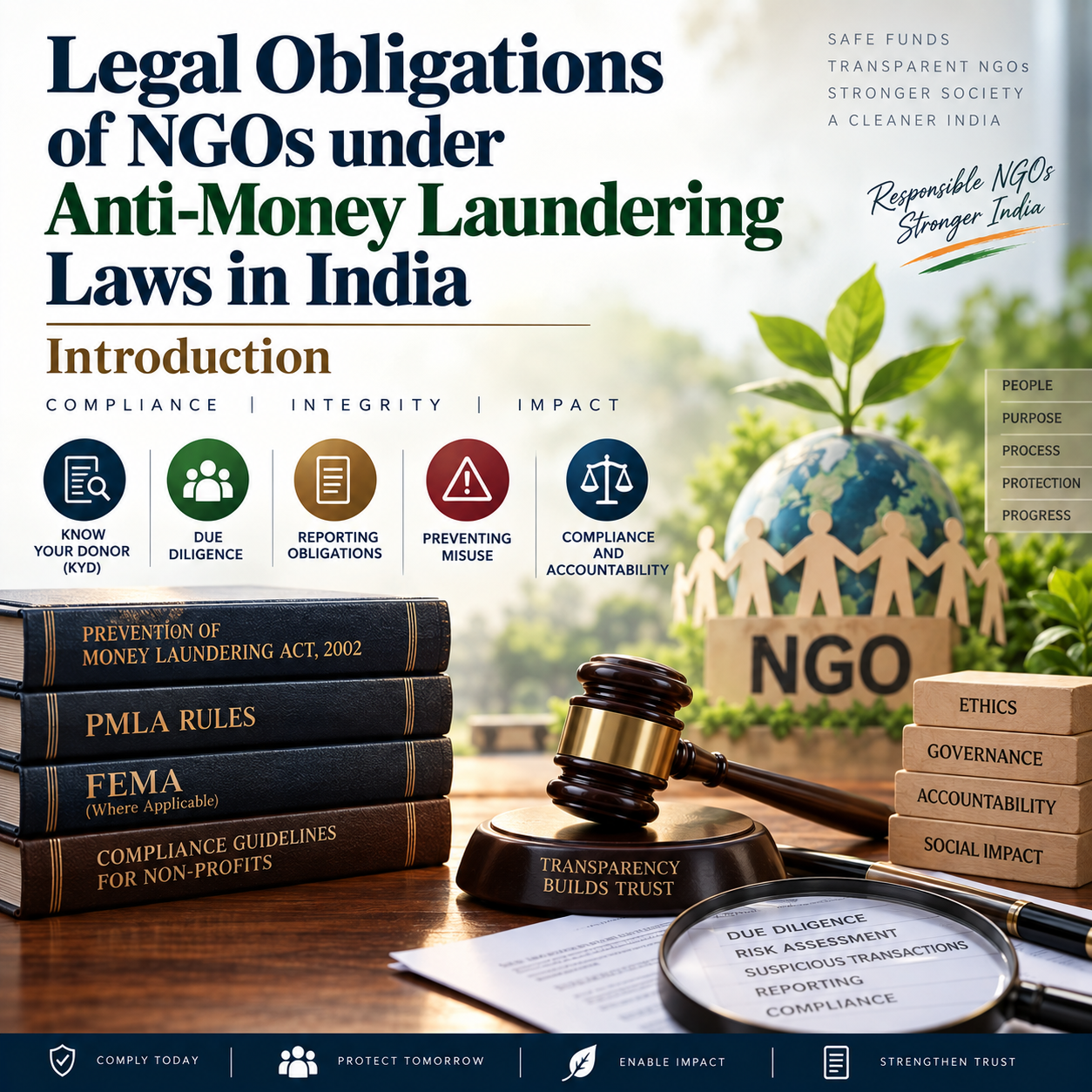
- Non-Governmental Organizations (NGOs), charitable trusts, societies, and Section 8 companies constitute an important pillar of civil society and contribute significantly toward social welfare, education, healthcare, environmental protection, rural development, women empowerment, poverty alleviation, disaster relief, and humanitarian assistance. Due to the increasing flow of domestic and foreign donations to the non-profit sector, governments across the world have strengthened regulatory mechanisms to ensure that charitable organizations are not misused for money laundering, terror financing, tax evasion, or diversion of funds.
- In recent years, regulatory authorities in India have intensified scrutiny over the financial activities of NGOs, especially those receiving foreign contributions or handling substantial public donations. International organizations such as the Financial Action Task Force (FATF) have also emphasized the importance of monitoring the non-profit sector because certain charitable entities may be vulnerable to misuse by criminal organizations and terrorist groups.
- Consequently, NGOs in India are subject to a complex legal framework involving the Prevention of Money Laundering Act, 2002 (PMLA), the Foreign Contribution (Regulation) Act, 2010 (FCRA), the Income-tax Act, 1961, banking regulations, and other financial compliance obligations.
- This article examines in detail the anti-money laundering obligations of NGOs in India, the applicable legal framework, regulatory expectations, compliance requirements, risks, liabilities, and best governance practices.
- 1. Meaning and Concept of Money Laundering
- Money laundering refers to the process through which illegally obtained money or proceeds of crime are concealed, disguised, or projected as legitimate income or assets. The objective of money laundering is to hide the illegal origin of funds and integrate them into the formal economy.
- What is money laundering?
- Money laundering is a financial crime through which illegally obtained money or “proceeds of crime” are concealed, disguised, or projected as lawful money or legitimate assets. The primary objective of money laundering is to hide the illegal origin of funds and integrate them into the formal financial system so that the money appears clean and legally earned.
- In simple terms, money laundering means converting “dirty money” into “clean money.”
- The illegal money may originate from Drug trafficking, Corruption, Fraud, Bribery, Tax evasion, Smuggling, Human trafficking, Illegal gambling, Terror financing, Cybercrime, Embezzlement, Extortion, Illegal mining, Financial scams and many others.
- Criminals cannot openly use illegally earned money because:
- Large unexplained transactions may attract government scrutiny,
- Banks and financial institutions monitor suspicious activities,
- Tax authorities may investigate unexplained wealth,
- Law enforcement agencies may trace proceeds of crime.
- Therefore, criminals attempt to “launder” money through various methods so that it appears to have been earned from legal activities.
- Money laundering is generally carried out in three stages:
- Placement,
- Layering,
- Integration.
- Each stage plays an important role in disguising the illegal origin of money.
- 1. Placement Stage
- Placement is the first stage of money laundering where illegally obtained money is introduced into the financial system.
- At this stage, criminals attempt to move cash or illegal proceeds away from direct possession and place them into:
- Bank accounts,
- Businesses,
- Charitable organizations,
- Financial institutions,
- Investments,
- Property transactions.
- This stage is considered the riskiest for criminals because the money is still directly connected to the original illegal activity.
- The main purpose of placement is:
- To separate criminals from physical cash,
- To avoid detection by authorities,
- To move illegal funds into the formal economy.
- Methods Used in Placement
- Criminals may use several methods such as:
- Depositing cash into bank accounts,
- Purchasing expensive assets,
- Donating money to organizations,
- Breaking large cash deposits into smaller amounts,
- Using intermediaries or fake businesses,
- Purchasing insurance or financial products.
- Example – Use of NGO Donations
- A criminal donates large amounts of illegal cash to an NGO and later receives fake consultancy payments or reimbursements from the organization.
- The original illegal money now appears as legitimate charitable funds.
- This is one form of placement.
- Risks During Placement
- Placement is the most vulnerable stage because:
- Banks may detect unusual deposits,
- Financial institutions monitor suspicious transactions,
- Large cash deposits may trigger reporting obligations,
- Authorities may investigate unexplained funds.
- 2. Layering Stage
- Layering is the second stage of money laundering where multiple complex transactions are carried out to conceal the original source of illegal money.
- At this stage, criminals attempt to create confusion and break the connection between the illegal activity and the money generated from it.
- The objective is to make tracing difficult for investigators.
- Purpose of Layering
- The purpose of layering is:
- To hide the true ownership of funds,
- To create multiple transaction trails,
- To confuse investigators,
- To distance money from the original crime.
- Common Layering Techniques
- Layering may involve:
- Multiple bank transfers,
- Shell companies,
- Fake invoices,
- Cross-border transactions,
- Cryptocurrency transfers,
- Purchase and resale of assets,
- Routing funds through charities or businesses,
- Fake consultancy agreements.
- Example – Fake NGO Projects
- An NGO receives suspicious donations and creates fictitious project expenses such as:
- Fake training programs,
- False beneficiary lists,
- Fabricated invoices,
- Bogus consultancy payments.
- Money is transferred through multiple persons and entities so that authorities cannot identify the original source.
- This is layering through charitable activities.
- Why Layering Is Difficult to Detect
- Layering creates:
- Complex transaction trails,
- Multiple intermediaries,
- International fund movement,
- Large volumes of paperwork,
- Confusing ownership structures.
- As a result, investigators may struggle to identify:
- Original source of funds,
- Real owner,
- Purpose of transactions.
- Role of Shell Entities in Layering
- Shell entities are companies or organizations that:
- Have no real business activity,
- Exist mainly on paper,
- Are used to transfer or conceal money.
- Criminals often use shell companies, trusts, and fake NGOs to move funds repeatedly and hide ownership.
- 3. Integration Stage
- Integration is the final stage of money laundering where laundered money re-enters the economy as apparently lawful income or legitimate assets.
- At this stage, the money appears “clean” because the original illegal source has been hidden through layering.
- The criminal can now openly use the funds without attracting suspicion.
- The objective of integration is:
- To give legal appearance to illegal money,
- To enable criminals to use wealth freely,
- To invest laundered funds into legitimate businesses or assets.
- Common Methods of Integration
- Laundered money may be integrated through:
- Purchase of real estate,
- Investments in businesses,
- Luxury assets,
- Fake salaries,
- Consultancy fees,
- Loans,
- Dividends,
- Charitable or commercial activities.
- Example 1 – Real Estate Purchase
- After multiple transactions and transfers, a criminal uses laundered funds to purchase luxury apartments.
- The property now appears to have been purchased using legitimate money.
- Example 2 – Fake Consultancy Income
- A person routes illegal money through several companies and later receives the amount as:
- Consultancy fees,
- Director remuneration,
- Professional income.
- The money now appears as legitimate earnings.
- Example 3 – Investment in Business
- A criminal launders money through shell entities and eventually invests it into:
- Restaurants,
- Hotels,
- NGOs,
- Construction companies,
- Startups.
- The funds are now part of the lawful economy.
- Combined Example of All Three Stages
- To understand the complete process, consider the following illustration:
- Step 1 – Placement
- A person earns ₹2 crore through illegal smuggling activities.
- He deposits small amounts into:
- Different bank accounts,
- NGO donation accounts,
- Cash-intensive businesses.
- The illegal cash enters the financial system.
- Step 2 – Layering
- The money is transferred:
- Through several shell companies,
- Through fake invoices,
- Across different countries,
- Through bogus project expenses.
- The original source becomes difficult to trace.
- Step 3 – Integration
- Finally, the funds are used to:
- Purchase property,
- Invest in businesses,
- Provide loans,
- Show lawful income.
- The money now appears legitimate.
- This completes the money laundering cycle.
- Importance of Anti-Money Laundering Laws
- Money laundering harms the economy and society because it:
- Encourages criminal activities,
- Facilitates corruption,
- Supports organized crime,
- Promotes terror financing,
- Weakens financial institutions,
- Reduces public trust,
- Causes tax losses to governments.
- Therefore, countries enact Anti-Money Laundering (AML) laws to:
- Detect suspicious transactions,
- Trace proceeds of crime,
- Freeze illegal assets,
- Punish offenders,
- Protect financial systems.
- In India, the primary law is the Prevention of Money Laundering Act, 2002 (PMLA).
- Conclusion
- Money laundering is a process through which illegally obtained money is disguised as legitimate income or assets. The process generally takes place in three stages:
- Placement,
- Layering,
- Integration.
- During placement, illegal money enters the financial system. During layering, multiple complex transactions conceal the source of funds. During integration, the laundered money re-enters the economy as apparently lawful wealth.
- Understanding these stages is essential for identifying suspicious transactions and strengthening anti-money laundering compliance mechanisms. NGOs, banks, businesses, and financial institutions must adopt strong governance systems, due diligence procedures, transparent accounting practices, and regulatory compliance measures to prevent misuse of financial systems for money laundering and related crimes.
- Vulnerability of NGOs to Money Laundering
- Non-Governmental Organizations (NGOs), charitable trusts, societies, and non-profit entities are established for public welfare and charitable purposes. However, due to the nature of their operations, certain NGOs may become vulnerable to misuse for money laundering, terror financing, fraud, tax evasion, and diversion of funds.
- International agencies such as the Financial Action Task Force (FATF) have identified specific operational and structural weaknesses that may expose NGOs to financial abuse. Understanding these vulnerabilities is essential for ensuring transparency, accountability, and compliance with anti-money laundering (AML) laws.
- The following factors significantly increase the risk of misuse of NGOs:
- 1. Anonymous Donations
- Many NGOs receive donations from members of the public, philanthropists, or supporters. In some cases, donations may be accepted without proper identification of the donor.
- Anonymous donations are contributions where:
- The identity of the donor is unknown,
- Incomplete information is available,
- No supporting documentation exists,
- Source of funds cannot be verified.
- Risks
- Anonymous donations create a serious risk because criminal persons may attempt to introduce illegal money into the financial system by disguising it as charitable donations. Since the actual source of funds remains hidden, therefore
- Authorities cannot verify legitimacy of money,
- Tracing proceeds of crime becomes difficult,
- NGOs may unknowingly receive illegal funds.
- A person involved in illegal activities may donate a large amount in cash to an NGO without disclosing identity. The money may later appear as a lawful charitable contribution in the books of the NGO.
- Legal Concerns
- Anonymous donations may:
- Attract scrutiny from tax authorities,
- Lead to investigation under anti-money laundering laws,
- Be taxable under the Income-tax Act,
- Raise suspicion regarding terror financing.
- Preventive Measures
- NGOs should:
- Maintain complete donor records,
- Collect PAN and address details,
- Encourage digital donations,
- Avoid accepting large anonymous cash donations,
- Conduct donor due diligence.
- 2. Cross-Border Funding
- Many NGOs receive grants and donations from foreign donors, international charities, foundations, and humanitarian organizations.
- Cross-border funding refers to:
- Receipt of foreign contributions,
- International bank transfers,
- Donations from overseas entities,
- Funding from foreign governments or institutions.
- Cross-border transactions are more difficult to monitor because:
- Funds pass through multiple jurisdictions,
- Different countries have different legal systems,
- Tracing actual donor identity becomes complex,
- Authorities may face difficulty verifying purpose of funds.
- Risks
- Criminal organizations may exploit international donations to:
- Conceal movement of illegal funds,
- Finance unlawful activities,
- Route money through shell entities.
- Legal Concerns
- A foreign entity may transfer funds to an NGO claiming they are for educational activities, but the funds may actually originate from unlawful sources.
- Improper foreign funding may lead to:
- Violation of FCRA provisions,
- Investigation by Enforcement Directorate,
- Freezing of bank accounts,
- Cancellation of FCRA registration,
- Proceedings under PMLA.
- Preventive Measures
- NGOs should:
- Receive foreign funds only through authorized FCRA accounts,
- Verify foreign donors,
- Maintain separate books of accounts,
- File accurate FC-4 returns,
- Monitor utilization of foreign contributions.
- 3. Weak Internal Controls
- Internal controls refer to the systems, procedures, and safeguards adopted by an organization to manage finances and operations properly.
- Weak internal controls may include:
- Lack of approval systems,
- Absence of financial supervision,
- No segregation of duties,
- Poor monitoring mechanisms,
- Inadequate documentation.
- Risks
- Where internal controls are weak:
- Fraud becomes easier,
- Employees may misuse funds,
- Fake expenses may be created,
- Unauthorized transactions may occur,
- Financial irregularities remain undetected.
- Criminals often target organizations with weak governance because such entities are easier to manipulate.
- Example:-
- If one individual handles collection, accounting, approval, and withdrawal of funds without supervision, chances of misappropriation increase significantly.
- Legal Concerns
- Weak controls may result in:
- Diversion of charitable funds,
- Violation of fiduciary duties,
- Financial fraud,
- Non-compliance with tax and regulatory laws.
- Preventive Measures
- NGOs should implement:
- Dual authorization systems,
- Internal audits,
- Approval hierarchies,
- Segregation of financial duties,
- Regular board supervision.
- 4. Cash-Based Transactions
- Certain NGOs, particularly those operating in rural or emergency areas, may rely heavily on cash transactions.
- Cash-based transactions include:
- Cash donations,
- Cash withdrawals,
- Cash payments to vendors or beneficiaries,
- Unrecorded petty cash expenses.
- Risks
- Cash transactions are difficult to trace because:
- They leave limited audit trails,
- Source and destination of money may remain unclear,
- Fake expenses can easily be created,
- Funds can be diverted without detection.
- Money laundering activities frequently involve cash because it enables concealment of financial movements.
- Example
- An NGO may withdraw large cash amounts claiming field expenses without maintaining proper vouchers or beneficiary records.
- Legal Concerns
- Excessive cash dealings may:
- Trigger bank reporting requirements,
- Attract income tax scrutiny,
- Raise suspicion under AML laws,
- Increase risk of fraud and embezzlement.
- Preventive Measures
- NGOs should:
- Use banking channels wherever possible,
- Maintain vouchers and receipts,
- Limit cash withdrawals,
- Encourage digital payments,
- Keep detailed expense records.
- 5. Inadequate Donor Verification
- Donor verification refers to the process of identifying and validating the persons or entities providing donations.
- Inadequate donor verification occurs when NGOs:
- Fail to verify donor identity,
- Do not check source of funds,
- Accept donations without documentation,
- Ignore suspicious donor behavior.
- Risks
- Without proper verification:
- Criminals may donate illegal funds,
- NGOs may unknowingly assist money laundering,
- Terror financing risks increase,
- Authorities may question legitimacy of donations.
- Example
- An NGO receives repeated large donations from unrelated foreign individuals without verifying their business activities or source of income.
- Legal Concerns
- Failure to verify donors may:
- Lead to regulatory investigations,
- Result in cancellation of exemptions,
- Create liability under FCRA and PMLA.
- Preventive Measures
- NGOs should:
- Collect KYC information,
- Verify donor identity,
- Maintain donation agreements,
- Assess source of funds for large donations,
- Report suspicious transactions where necessary.
- 6. Use of Multiple Intermediaries
- Some NGOs work through partner organizations, agents, volunteers, contractors, or local coordinators.
- Intermediaries may include:
- Sub-grantee organizations,
- Local implementing partners,
- Consultants,
- Field coordinators,
- Volunteer groups.
- Risks
- Use of multiple intermediaries may:
- Reduce direct supervision,
- Complicate tracking of funds,
- Create opportunities for fake transactions,
- Enable diversion of money.
- Examples
- As money passes through several layers, identifying actual utilization becomes difficult.
- Legal Concerns
- An NGO transfers grant money to several local organizations without verifying whether projects are genuinely implemented.
- Improper monitoring of intermediaries may:
- Result in misuse of charitable funds,
- Violate donor agreements,
- Lead to regulatory action.
- Preventive Measures
- NGOs should:
- Conduct due diligence on partners,
- Enter written agreements,
- Monitor project implementation,
- Obtain utilization certificates,
- Conduct field inspections.
- 7. Poor Accounting Systems
- Accounting systems help maintain accurate financial records and ensure transparency.
- Poor accounting systems may involve:
- Incomplete book keeping,
- Delayed entries,
- Missing records,
- Lack of reconciliation,
- Manual and error-prone accounting methods.
- Risk
- Poor accounting creates opportunities for:
- Manipulation of records,
- Concealment of fraud,
- Unauthorized expenditures,
- Fictitious transactions.
- Authorities may also find it difficult to verify proper utilization of funds.
- Example
- An NGO fails to maintain separate records for foreign and domestic donations, leading to confusion regarding utilization.
- Legal Concerns
- Poor accounting may lead to:
- Audit qualifications,
- Tax penalties,
- Loss of donor confidence,
- Regulatory investigations.
- Preventive Measures
- NGOs should:
- Maintain proper books of account,
- Use accounting software,
- Conduct reconciliations regularly,
- Preserve supporting documents,
- Obtain periodic audits.
- 8. Lack of Regulatory Oversight in Smaller Organizations
- Smaller NGOs often operate with limited supervision and fewer compliance mechanisms.
- Smaller organizations may:
- Have limited staff,
- Lack professional accountants,
- Avoid regular audits,
- Operate informally.
- Risk
- Limited oversight increases vulnerability because:
- Compliance violations may go unnoticed,
- Financial systems may remain weak,
- Record maintenance may be poor,
- Fraud detection becomes difficult.
- Criminals may exploit smaller organizations because regulatory scrutiny is often lower.
- Example
- A small rural NGO may receive local donations and operate entirely through informal cash systems without proper accounting or compliance filings.
- Legal Concerns
- Lack of oversight may result in:
- Non-compliance with tax laws,
- FCRA violations,
- Financial irregularities,
- Increased exposure to AML investigations.
- Preventive Measures
- Small NGOs should:
- Seek professional compliance assistance,
- Conduct periodic audits,
- Maintain statutory records,
- Ensure board supervision,
- Improve accounting and governance systems.
- NGOs perform vital charitable and humanitarian functions; however, certain operational vulnerabilities may expose them to misuse for money laundering, terror financing, fraud, and financial misconduct. Factors such as anonymous donations, cross-border funding, weak internal controls, cash-based transactions, poor accounting systems, and inadequate oversight significantly increase such risks.
- To protect themselves from legal liability and reputational harm, NGOs must adopt robust governance practices, transparent accounting systems, proper donor verification mechanisms, and strong compliance frameworks. Effective anti-money laundering safeguards not only ensure legal compliance but also strengthen public confidence and institutional credibility within the non-profit sector.
- The non-profit sector is considered vulnerable to financial abuse because NGOs often:
- Receive donations from multiple domestic and international sources,
- Operate in remote or conflict-prone areas,
- Work with volunteers and intermediaries,
- Conduct humanitarian relief activities requiring rapid fund movement,
- Enjoy tax exemptions and public trust,
- Maintain extensive cash expenditure in field operations.
- Certain criminal networks may misuse NGOs for:
- Diversion of foreign donations,
- Channeling proceeds of crime,
- Funding unlawful activities,
- Terror financing,
- Creating fictitious charitable projects,
- Providing accommodation entries,
- Avoiding taxation.
- The Financial Action Task Force (FATF), an international body combating money laundering and terror financing, has issued recommendations requiring countries to monitor the non-profit sector while ensuring that legitimate charitable activities are not unnecessarily restricted.
- 2. Legal Framework Governing AML Compliance for NGOs in India
- 2.1 Prevention of Money Laundering Act, 2002 (PMLA)
- The Prevention of Money Laundering Act, 2002 is the principal anti-money laundering legislation in India.
- Objectives of PMLA
- The Act aims to:
- Prevent money laundering,
- Confiscate proceeds of crime,
- Combat financing of terrorism,
- Establish obligations for financial institutions and intermediaries.
- Applicability to NGOs
- Although NGOs are generally not classified as “reporting entities” under Section 2(1)(wa) of the PMLA unless engaged in specified financial activities, they may still come under investigation where:
- Funds are linked to scheduled offences,
- Donations originate from criminal activities,
- Funds are diverted for unlawful purposes,
- Terror financing is suspected,
- Foreign contributions are improperly utilized.
- Powers of Enforcement Directorate (ED)
- The Enforcement Directorate may:
- Summon office bearers,
- Conduct searches and seizures,
- Attach properties,
- Freeze bank accounts,
- Investigate financial transactions,
- Prosecute individuals involved in money laundering.
- If NGO funds are found connected with proceeds of crime, assets may be provisionally attached under the PMLA.
- 3.2 Foreign Contribution (Regulation) Act, 2010 (FCRA)
- The FCRA is one of the most significant laws governing NGOs receiving foreign contributions.
- Purpose of FCRA
- The Act regulates acceptance and utilization of foreign contributions to ensure that such funds do not adversely affect:
- National security,
- Sovereignty and integrity of India,
- Public interest,
- Electoral processes,
- Social harmony.
- Mandatory Requirements Under FCRA
- An NGO receiving foreign contribution must:
- Obtain FCRA registration or prior permission,
- Open a designated FCRA bank account at the specified branch of the State Bank of India, New Delhi,
- Receive foreign contribution only through authorized banking channels,
- Maintain separate books of account for foreign contributions,
- Use funds only for approved objectives,
- File annual returns in Form FC-4,
- Maintain records of donors and utilization,
- Ensure that administrative expenses remain within prescribed limits,
- Avoid transfer of foreign contribution to unregistered entities.
- AML Relevance of FCRA
- FCRA acts as an important anti-money laundering mechanism because it:
- Tracks foreign inflows,
- Ensures transparency in utilization,
- Prevents anonymous international funding,
- Enables government monitoring of suspicious transactions.
- Consequences of Violation
- Violation of FCRA provisions may result in:
- Suspension or cancellation of registration,
- Seizure of funds,
- Monetary penalties,
- Criminal prosecution,
- Blacklisting from future foreign funding,
- Investigation under PMLA and other criminal laws.
- 2.2 Income-tax Act, 1961
- The Income-tax Act governs tax exemptions available to charitable organizations.
- Registration Requirements
- NGOs seeking tax exemption must obtain:
- Registration under Section 12AB,
- Approval under Section 80G for donor deductions.
- AML Related Compliance Under Tax Laws
- NGOs must:
- Maintain proper books of account,
- Use income solely for charitable purposes,
- Avoid private benefit to trustees,
- Maintain transparency in donations,
- Disclose financial information in returns.
- Anonymous Donations
- Section 115BBC taxes certain anonymous donations received by charitable organizations.
- Authorities may investigate:
- Bogus donations,
- Circular funding arrangements,
- Accommodation entries,
- Artificial inflation of donations,
- Misuse of tax exemptions.
- Audit and Reporting
- NGOs crossing prescribed thresholds must:
- Obtain audit reports,
- File Income Tax Return in ITR-7,
- Disclose utilization of funds,
- Report related-party transactions.
- Failure may lead to:
- Cancellation of exemptions,
- Tax liabilities,
- Interest and penalties,
- Prosecution proceedings.
- 3. Banking and Financial Compliance Obligations
- 3.1 KYC Compliance
- Banks are required to conduct Know Your Customer (KYC) verification of NGOs under Reserve Bank of India (RBI) guidelines.
- NGOs must provide:
- Registration documents,
- PAN,
- Address proof,
- Details of trustees/directors,
- Beneficial ownership information,
- FCRA registration (where applicable).
- 3.2 Monitoring of Transactions
- Banks monitor NGO accounts for:
- Unusual cash deposits,
- Frequent international remittances,
- Structuring of transactions,
- Rapid movement of funds,
- Transactions inconsistent with stated objectives.
- Suspicious transactions may be reported to the Financial Intelligence Unit – India (FIU-IND).
- 3.3 Restrictions on Cash Transactions
- Excessive cash transactions increase AML risks.
- NGOs should:
- Prefer banking channels,
- Maintain proper vouchers,
- Avoid large anonymous cash donations,
- Ensure traceability of financial transactions.
- 4. Governance Obligations and Internal Controls
- Effective governance mechanisms are critical for AML compliance.
- 4.1 Board Oversight
- Trustees and directors must:
- Supervise financial management,
- Approve major transactions,
- Monitor utilization of funds,
- Ensure legal compliance.
- Failure of oversight may attract personal liability in certain circumstances.
- 4.2 Internal Financial Controls
- NGOs should implement:
- Segregation of duties,
- Dual authorization systems,
- Approval hierarchies,
- Budgetary controls,
- Vendor verification,
- Procurement policies.
- 4.3 Documentation and Record Maintenance
- Proper records should include:
- Donation receipts,
- Bank statements,
- Invoices,
- Agreements,
- Beneficiary records,
- Utilization certificates,
- Audit reports.
- Records must be preserved for the period prescribed under applicable laws.
- 5. Due Diligence Obligations
- 5.1 Donor Due Diligence
- NGOs should verify:
- Identity of donors,
- Source of funds,
- Legitimacy of donations,
- Sanctions or watchlist status where necessary.
- Special caution should be exercised for:
- Large foreign donations,
- Politically exposed persons,
- High-risk jurisdictions,
- Unusual funding structures.
- 5.2 Vendor and Partner Due Diligence
- NGOs should verify third parties involved in projects to prevent misuse of charitable funds.
- This includes:
- Vendor background checks,
- Verification of partner organizations,
- Monitoring project implementation,
- Reviewing utilization certificates.
- 6. Role of International Standards and FATF Recommendations
- The Financial Action Task Force (FATF) has issued recommendations concerning the non-profit sector.
- Countries are expected to:
- Identify vulnerable organizations,
- Monitor financial transparency,
- Prevent terror financing,
- Encourage risk-based supervision.
- India, being a FATF member country, has incorporated several AML safeguards affecting NGOs through:
- FCRA regulations,
- Banking supervision,
- Financial reporting norms,
- Enhanced scrutiny mechanisms.
- 7. Consequences of Non-Compliance
- Non-compliance with AML obligations may lead to severe civil and criminal consequences.
- 7.1 Regulatory Consequences
- Suspension of registration,
- Cancellation of licenses,
- Freezing of bank accounts,
- Denial of tax exemptions.
- 7.2 Financial Consequences
- Penalties,
- Tax demands,
- Recovery proceedings,
- Loss of grants and CSR funding.
- 7.3 Criminal Liability
- In serious cases involving proceeds of crime or terror financing:
- Criminal prosecution may be initiated,
- Office bearers may face imprisonment,
- Assets may be attached or confiscated.
- 7.4 Reputational Damage
- Loss of public confidence may significantly impact:
- Donor support,
- International partnerships,
- Government approvals,
- Organizational credibility.
- 8. Best Practices for AML Compliance by NGOs
- To strengthen compliance and reduce legal risks, NGOs should adopt the following best practices:
- Governance Measures
- Adopt written AML policies,
- Establish compliance committees,
- Conduct periodic board reviews,
- Maintain conflict-of-interest policies.
- Financial Controls
- Avoid excessive cash handling,
- Use digital payment systems,
- Maintain transparent accounting,
- Conduct regular internal audits.
- Documentation
- Preserve donor records,
- Maintain utilization evidence,
- Ensure accurate statutory filings.
- Training and Awareness
- Train staff and volunteers,
- Educate management regarding compliance obligations,
- Conduct periodic risk assessments.
- Legal Compliance
- File statutory returns on time,
- Renew registrations regularly,
- Monitor amendments in laws,
- Obtain professional advice where necessary.
- 9. Conclusion
- NGOs perform essential social and humanitarian functions and enjoy significant public trust. However, with increasing domestic and international funding, the risk of misuse of charitable organizations for money laundering and terror financing has become a matter of global concern.
- Indian laws such as the Prevention of Money Laundering Act, 2002, the Foreign Contribution (Regulation) Act, 2010, and the Income-tax Act, 1961 impose substantial obligations on NGOs to maintain transparency, accountability, and financial integrity.
- Compliance with anti-money laundering regulations is not merely a legal formality but a crucial component of responsible governance. Proper financial controls, due diligence mechanisms, transparent accounting practices, and ethical administration are essential for ensuring that NGOs continue to fulfill their charitable objectives while maintaining public confidence and regulatory compliance.
- A proactive compliance framework ultimately protects NGOs from legal exposure, enhances donor trust, strengthens institutional credibility, and contributes toward the integrity of the non-profit sector as a whole.