




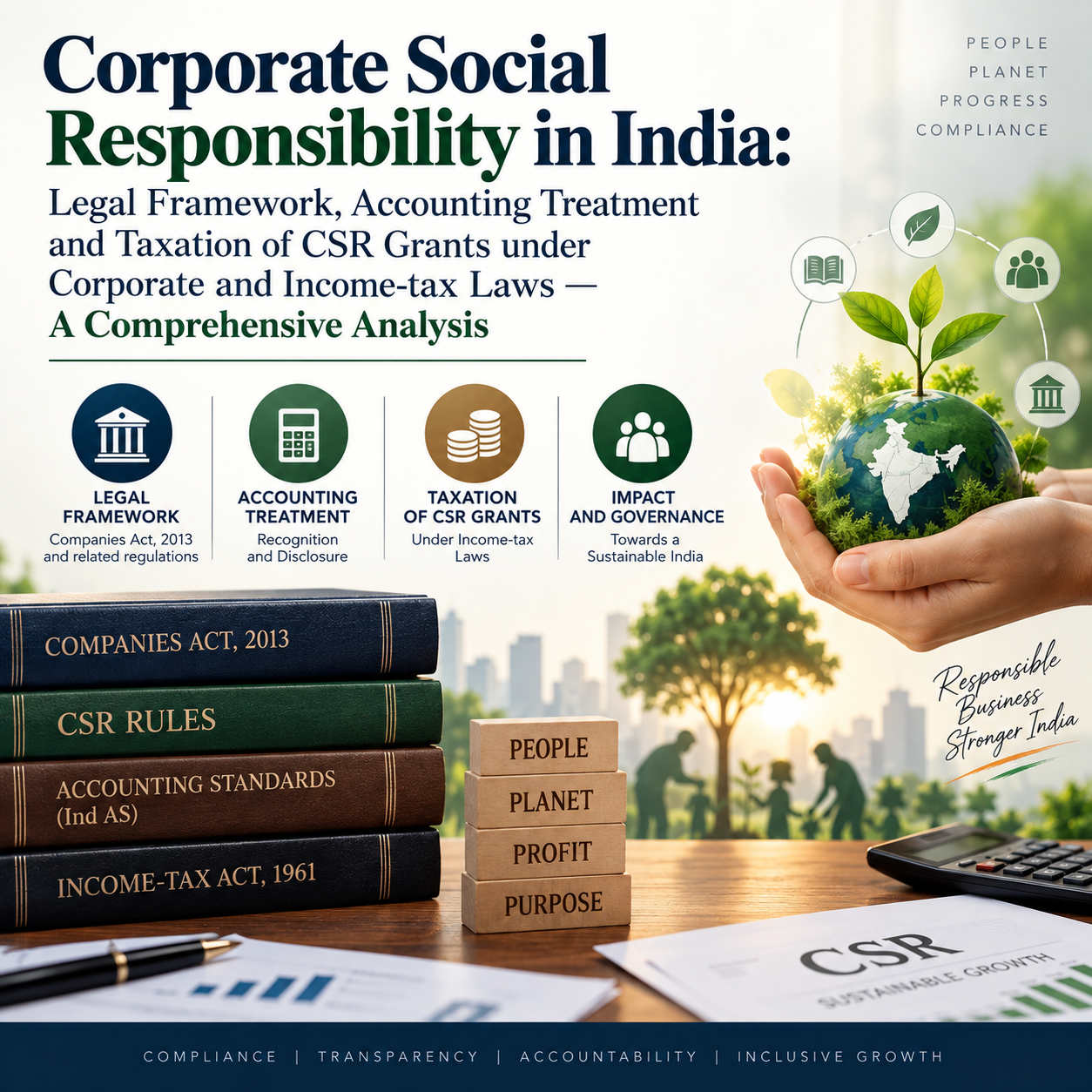
- The statutory recognition of Corporate Social Responsibility (CSR) under the Companies Act, 2013 transformed corporate philanthropy in India from a voluntary ethical commitment into a mandatory legal obligation. India became the first major jurisdiction in the world to legally mandate qualifying companies to spend a prescribed percentage of profits on socially beneficial activities. Over time, the CSR framework has evolved into a comprehensive compliance regime involving corporate governance, statutory reporting, audit requirements, implementing agency regulation, accounting treatment, and taxation implications under the Income-tax Act.
- The legal and financial treatment of CSR grants has emerged as one of the most significant areas of practical and interpretative complexity. Questions frequently arise concerning deductibility of CSR expenditure, treatment of unspent CSR obligations, accounting recognition of grants, taxation in the hands of recipient NGOs, corpus donations, GST implications, and regulatory overlap between the Ministry of Corporate Affairs and income-tax authorities.
- This article critically analyses the statutory framework governing CSR in India with special focus upon accounting and taxation of CSR grants and contributions made by companies in discharge of their CSR obligations. The article also examines practical challenges, judicial trends, and emerging governance standards shaping CSR compliance in India.
- Corporate entities today are no longer viewed merely as profit-generating commercial institutions. Modern corporate jurisprudence increasingly recognises that corporations are social institutions possessing obligations not only towards shareholders but also towards employees, consumers, local communities, and society at large. The concept of Corporate Social Responsibility (CSR) is rooted in this broader philosophy of stakeholder capitalism and sustainable development.
- India formally institutionalized CSR through insertion of Section 135 into the Companies Act, 2013. The provision represented a watershed moment in corporate regulation by imposing mandatory social spending obligations upon qualifying companies. The statutory CSR framework was introduced against the backdrop of widening socio-economic disparities, increasing environmental concerns, and the recognition that private capital must contribute towards inclusive national development.
- Initially perceived as a philanthropic compliance obligation, CSR has now evolved into a sophisticated legal and governance ecosystem involving:
- Corporate governance mechanisms;
- Statutory spending obligations;
- Financial reporting standards;
- Audit and disclosure requirements;
- Registration and regulation of implementing agencies;
- Impact assessment;
- Taxation and accounting treatment;
- ESG (Environmental, Social and Governance) compliance standards.
- The increasing volume of CSR spending in India has simultaneously attracted enhanced regulatory scrutiny. Tax authorities, auditors, regulators, and stakeholders now examine whether CSR expenditure is genuine, properly utilised, correctly accounted for, and compliant with applicable tax laws.
- Particularly significant is the treatment of CSR grants given to NGOs, charitable trusts, societies, and Section 8 companies. Such grants raise complex legal questions regarding deductibility, corpus treatment, income recognition, utilization restrictions, GST liability, and tax exemption.
- This article seeks to comprehensively analyse the legal framework governing CSR and the accounting and taxation consequences arising from CSR grants.
- Historical Evolution of CSR in India
- Although CSR became statutory only in 2013, the idea of corporate philanthropy has deep historical roots in India.
- Traditional business families such as the Tata Group, Birla Group, Bajaj Group, and Godrej Group historically engaged in:
- Educational philanthropy;
- Establishment of hospitals;
- Rural development initiatives;
- Scientific and cultural promotion.
- However, these activities remained largely voluntary and philanthropic in character.
- The transformation from voluntary philanthropy to statutory CSR occurred through the Companies Act, 2013, influenced by several factors:
- Rising expectations from corporate sector;
- Global sustainable development discourse;
- Increasing concentration of corporate wealth;
- Demand for inclusive economic growth;
- Need for structured accountability in social spending.
- India’s CSR model differs significantly from Western jurisdictions because it imposes mandatory expenditure obligations rather than relying exclusively upon voluntary corporate ethics.
- Constitutional and Theoretical Basis of CSR
- Although CSR obligations arise under corporate legislation, the philosophical foundation of CSR may be traced to constitutional principles embodied in the Directive Principles of State Policy under the Constitution of India.
- CSR advances constitutional objectives relating to:
- Social justice;
- Reduction of inequalities;
- Promotion of education;
- Public health;
- Environmental protection;
- Welfare of weaker sections.
- CSR also aligns with modern theories of corporate governance including:
- (A) Stakeholder Theory
- Corporations owe responsibilities not merely to shareholders but to all stakeholders affected by corporate activities.
- (B) Sustainable Development Theory
- Economic growth must be balanced with environmental sustainability and social welfare.
- (C) Triple Bottom Line Approach
- Corporate performance must be evaluated on three parameters i.e. Profit, People and Planet.
- The Indian CSR framework attempts to integrate these principles within statutory corporate regulation.
- Statutory Framework under the Companies Act, 2013
- The principal provision governing CSR is Section 135 of the Companies Act, 2013 read with the Companies (Corporate Social Responsibility Policy) Rules, 2014 as amended from time to time.
- CSR provisions apply to companies satisfying any of the following thresholds during the immediately preceding financial year:
- Criteria Threshold
- Net Worth ₹500 Crore or More
- Turnover ₹1,000 Crore or More
- Net Profit ₹5 Crore or More
- Eligible companies must spend at least 2% of the average net profits of the preceding three financial years on CSR activities.
- CSR Committee and Governance Structure
- Qualifying companies are required to constitute a CSR Committee of the Board consisting of directors as prescribed under law.
- The CSR Committee performs critical functions including:
- Formulation of CSR Policy;
- Recommendation of CSR expenditure;
- Identification of projects;
- Monitoring implementation;
- Ensuring utilisation compliance.
- The Board of Directors retains ultimate responsibility for CSR compliance and disclosures.
- The legislative emphasis upon governance mechanisms demonstrates that CSR is no longer viewed merely as charitable donation but as a structured corporate compliance function.
- Schedule VII Activities
- CSR expenditure must relate to activities specified under Schedule VII of the Companies Act.
- Eligible activities include:
- Eradicating hunger and poverty;
- Promotion of education;
- Promotion of gender equality;
- Environmental sustainability;
- Protection of national heritage;
- Rural development projects;
- Slum area development;
- Disaster management;
- Contributions to government relief funds;
- Research and innovation projects.
- The Ministry of Corporate Affairs has repeatedly clarified that Schedule VII should receive liberal interpretation to encourage socially beneficial initiatives.
- Modes of CSR Implementation
- CSR activities may be implemented through:
- Direct implementation by the company;
- Section 8 companies;
- Registered public charitable trusts;
- Registered societies;
- Implementing agencies registered through Form CSR-1.
- The CSR-1 registration mechanism was introduced to create transparency and accountability in the ecosystem of NGOs receiving corporate CSR funds.
- The registration system enables:
- Centralised verification;
- Monitoring of implementing agencies;
- Better regulatory oversight;
- Prevention of misuse of CSR funds.
- Nature and Classification of CSR Grants
- CSR contributions may assume multiple legal and accounting forms depending upon the nature of the arrangement.
- Major categories include:
- (A) Revenue Grants
- Operational grants for conducting charitable programmes such as:
- Educational projects;
- Healthcare camps;
- Skill development programmes.
- (B) Capital Grants
- Grants for creation of infrastructure such as:
- Schools;
- Hospitals;
- Sanitation facilities;
- Community centres.
- (C) Corpus Grants
- Permanent endowment contributions intended to form part of corpus fund.
- (D) Reimbursement Grants
- Amounts reimbursing expenditure already incurred by implementing agencies.
- (E) Conditional Grants
- Funds subject to utilisation conditions and reporting obligations.
- The legal character of the grant directly impacts accounting recognition and tax treatment.
- Accounting Treatment of CSR Expenditure in Corporate Books
- The accounting treatment of CSR expenditure is governed by:
- Companies Act;
- Schedule III;
- Accounting Standards;
- Ind AS principles;
- ICAI Guidance Notes.
- Whether CSR Expenditure Creates Asset
- One important issue concerns whether expenditure resulting in creation of assets like construction of schools, community hospitals, sanitation facilities etc. can be capitalised. Generally, where the asset is not controlled by the company and is transferred for public benefit, the expenditure is treated as CSR expense rather than capital asset of the company.
- However, accounting treatment may vary depending upon ownership, control, and economic benefit.
- Recognition of CSR Liability
- CSR obligation becomes a statutory liability once the conditions under Section 135 are satisfied.
- Where the company fails to spend the required amount:
- Unspent amounts relating to ongoing projects must be transferred to “Unspent CSR Account”;
- Other unspent amounts must be transferred to specified funds.
- Thus, accounting standards increasingly require recognition of CSR obligations as liabilities in financial statements.
- Treatment of Surplus Arising from CSR Projects
- Any surplus arising from CSR activities like Income from CSR training programmes, Sale proceeds from CSR products, Interest on CSR project funds cannot ordinarily form part of business profits.
- Such surplus must generally be:
- Reinvested into CSR activities;
- Transferred to Unspent CSR Account;
- Utilised only for permissible CSR purposes.
- This ensures that CSR projects do not become indirect profit centres.
- Tax Deductibility of CSR Expenditure
- One of the most controversial aspects concerns tax deductibility.
- Explanation 2 to Section 37(1) of the Income-tax Act expressly disallows CSR expenditure incurred pursuant to Section 135.
- The provision states that CSR expenditure shall not be deemed to have been incurred wholly and exclusively for purposes of business.
- The rationale underlying the disallowance includes:
- CSR is statutory obligation rather than commercial expenditure;
- Allowing deduction would indirectly subsidise CSR spending through tax incentives;
- The burden of social responsibility should be borne by corporates themselves.
- Exceptions and Specific Deductions
- Despite disallowance under Section 37(1), deductions may still be available under specific provisions such as:
- Provision Nature of Deduction
- Section 80G Approved charitable donations
- Section 35 Scientific research
- Section 35CCD Skill development projects
- Section 80GGA Rural development and scientific research
- However, deduction is available only if independent statutory conditions are satisfied.
- Judicial Developments
- Indian courts and tribunals have considered several disputes concerning CSR deductibility.
- Judicial trends indicate:
- Pure CSR expenditure mandated by law generally remains disallowable;
- Expenditure having direct nexus with business operations may still qualify independently;
- Environmental compliance expenditure may be distinguishable from pure CSR.
- Courts increasingly examine the substance and commercial connection of expenditure rather than merely its nomenclature.
- Taxation of CSR Grants in Hands of NGOs
- The taxation consequences in the hands of recipient organisations depend upon Registration status, Nature of grant, Corpus direction, Application of income, Compliance with exemption provisions.
- Corpus Contributions
- Where CSR contribution is accompanied by specific written direction that it shall form part of corpus. It may qualify as corpus donation. Separate accounting treatment applies. Exemption may be available subject to statutory conditions. However, mere nomenclature is insufficient. Documentary evidence demonstrating donor intention becomes crucial.
- Non-Corpus CSR Grants
- Project grants and operational grants generally constitute income of the NGO.
- However, exemption may continue if:
- The organisation possesses valid registration;
- Income is applied towards charitable purposes;
- Statutory compliance is maintained.
- Failure to comply may expose the organisation to taxation.
- Anonymous Donation Provisions and CSR
- CSR grants ordinarily do not fall within anonymous donation provisions because:
- Corporate donor identity is fully documented;
- Grants move through banking channels;
- Board approvals exist;
- Grant agreements are executed.
- Therefore, taxation under anonymous donation provisions rarely arises in CSR transactions.
- GST Implications of CSR Activities
- The GST implications of Corporate Social Responsibility (CSR) expenditure continue to remain one of the most complex and evolving areas under indirect tax law in India. While CSR obligations arise under Section 135 of the Companies Act, 2013, the GST consequences of expenditure incurred towards such obligations are governed by the provisions of the Central Goods and Services Tax Act, 2017 (CGST Act).
- 1. Availability of ITC
- Before 01.10.2023
- The entitlement to ITC is governed by Section 16 of the CGST Act, 2017. Section 16(1) provides that a registered person shall be entitled to take credit of input tax charged on supply of goods or services which are used or intended to be used “in the course or furtherance of business.”
- Therefore, the core legal question becomes “Whether CSR expenditure can be regarded as expenditure incurred “in the course or furtherance of business”?
- If the answer is affirmative, ITC may be available. If not, ITC may be denied.
- Besides, Section 17(5)(h) also mandates that businesses cannot claim Input Tax Credit (ITC) on goods that are lost, stolen, destroyed, written off, or disposed of by way of gift or free samples. Therefore, department argued that:
- Goods distributed under CSR are given free of cost;
- Therefore they are "gifts";
- Consequently ITC should be blocked under Section 17(5)(h).
- While taxpayers argued that the CSR expenditure is fundamentally different from a Gift because a gift is voluntary, gratuitous and motivated by generosity while CSR expenditure is mandatory, legally enforceable and incurred pursuant to a statutory obligation.
- UP Authority For Advance Ruling (UP AAR) in Dwarikesh Sugar Industries Ltd. held that goods distributed under CSR not Gifts because CSR expenditure is incurred because of statutory obligations and such expenditure is incurred in the course of business. This ruling became a major precedent in favour of taxpayers.
- Kerala AAR in Polycab Wires P. Ltd. adopted the opposite view. It held that material distributed free of cost under CSR are akin to gifts. Therefore, ITC is blocked under section 17(5)(h) of the Act.
- So, there was substantial uncertainty in this regard.
- After 01.10.2023
- To end this controversy, the Finance Act, 2023 inserted a new clause (fa)to section 17(5) which mandates that ITC shall not be available in respect of Goods or services or both received by a taxable person which are used or intended to be used for activities relating to obligations under CSR referred to in Section 135 of the Companies Act, 2013. This amendment was brought in force from 01.10.2023. Thus, after 01.10.2023, the ITC is expressly blocked by virtue of Section 17(5)(fa).
- Thus, the Finance Act, 2023 inserted Section 17(5)(fa) with effect from 1 October 2023 specifically blocking ITC on Goods or services used for activities relating to CSR obligations under Section 135 of the Companies Act.
- As a result, Prior to 01.10.2023, The business nexus question was crucial because ITC depended on whether CSR expenditure satisfied Section 16(1).
- After 01.10.2023, Even if CSR expenditure is accepted as being in the course or furtherance of business, ITC is specifically denied by Section 17(5)(fa).
- Therefore, the debate regarding business nexus remains relevant primarily for:
- Pre-October 2023 periods;
- Pending litigation;
- Interpretation of earlier assessments.
- However, for periods after 01.10.2023, ITC is nevertheless blocked under Section 17(5)(fa).
- The stronger legal and judicial view is that mandatory CSR expenditure under Section 135 of the Companies Act, 2013 is incurred in the course or furtherance of business because it is a statutory obligation arising directly from the conduct of business activities. Compliance with law is an integral component of business operations, and CSR expenditure would not arise but for the existence of the business itself. Consequently, prior to 1 October 2023, taxpayers had substantial grounds to claim ITC on CSR expenditure. However, the insertion of Section 17(5)(fa) now expressly blocks such credit, notwithstanding the existence of a business nexus.
- 2. Whether Free Distribution under CSR Constitutes Supply
- CSR projects frequently involve free distribution of goods such as Medicines, Educational kits, Food items, Blankets, Sanitary products, Medical equipment.
- This raises another important issue which is “Whether free distribution of goods under CSR attracts GST”?
- Under Section 7 of the CGST Act, “supply” includes all forms of goods or services or both made or agreed to be made for a consideration by a person in the course or furtherance of business. Thus “Supply” generally requires Consideration and Business nexus.
- Where goods are distributed entirely free of cost without consideration, GST may ordinarily not apply unless specifically covered under Schedule I. Schedule I provides for activities which are treated as taxable supplies under GST even if they are made without any monetary consideration.
- One relevant category under Schedule I includes:
- “Permanent transfer or disposal of business assets where ITC has been availed.”
- Therefore, if:
- A company purchases goods,
- Avails ITC on such goods,
- Subsequently distributes them free under CSR,
- The Authorities may argue that GST becomes payable because there has been permanent disposal of business assets.
- However, this issue remains highly interpretational and fact-specific.
- Where companies avail ITC on CSR-related procurements and later distribute goods free of cost, disputes may arise regarding:
- Reversal of ITC;
- Deemed supply provisions;
- Valuation of taxable supply.
- The law presently lacks comprehensive clarity on these aspects, leading to varying industry practices.
- Effect of Section 17(5)(fa)
- From 1 October 2023, Section 17(5)(fa) specifically blocks ITC on goods and services used for CSR obligations under Section 135 of the Companies Act.
- However, this amendment affects Input Tax Credit. It does not automatically make free CSR distribution a taxable supply.
- Therefore:
- ITC may be denied under Section 17(5)(fa);
- Yet the free distribution itself may continue to remain outside GST because no consideration is involved.
- 3. Taxability of Services Supplied by Implementing Agencies
- CSR activities are often implemented through NGOs, Charitable trusts, Section 8 companies, Professional consulting firms, Social impact organizations.
- The GST treatment depends upon the nature of services supplied. Certain charitable activities enjoy exemption under GST notifications. Examples include activities relating to Public health, Relief to poor, Advancement of religion, Educational programmes. Where the implementing agency performs exempt charitable functions, GST may not apply.
- However, where implementing agencies provide professional or commercial services such as CSR project management, Consultancy, Monitoring and evaluation, Impact assessment, Administrative support, Research services, such services may qualify as taxable supplies liable to GST.
- Illustration
- Suppose a company appoints an NGO for implementation of a sanitation programme. Two possibilities may arise:
- Situation 1:
- The NGO directly undertakes charitable sanitation activities.
- GST exemption may potentially apply.
- Situation 2:
- The NGO charges separate consultancy and project management fees.
- Such professional services may attract GST.
- Thus, the nature of activity and contractual structure become critical.
- 4. GST on Construction of CSR Assets
- Another major area of controversy concerns construction activities undertaken under CSR projects like schools, hospitals, Toilets, Community Centres, Water facilities. Prior to 1 October 2023, there was no specific clause in Section 17(5) of the CGST Act dealing with CSR expenditure. Therefore, litigation focused mainly on whether CSR expenditure was hit by Section 17(5)(h).
- Position After 01.10.2023
- The introduction of Section 17(5)(fa) changed the position significantly. Now ITC is specifically blocked on Goods or services used for activities relating to CSR obligations under Section 135 of the Companies Act. Therefore, even though CSR expenditure is for construction of CSR Assets, ITC may still be denied because of the specific statutory restriction under Section 17(5)(fa).
- 5. CSR Expenditure and Personal Consumption
- Section 17(5) also blocks ITC relating to personal consumption.The CGST Act does not define "personal consumption". In common legal understanding, personal consumption refers to
- Consumption by the proprietor;
- Consumption by directors;
- Consumption by employees for private purposes;
- Consumption by family members or related persons;
- Goods or services used for non-business personal enjoyment.
- So there was a lot of uncertainty regarding the interpretation of the term “Personal Consumption” before 01.10.2023. Occasionally authorities attempt to argue that certain welfare-related expenditures are non-business or personal in nature.
- Position After 01.10.2023
- The introduction of Section 17(5)(fa) changed the position significantly. Now ITC is specifically blocked on Goods or services used for activities relating to CSR obligations under Section 135 of the Companies Act. Therefore, even though CSR expenditure is not personal consumption, ITC may still be denied because of the specific statutory restriction under Section 17(5)(fa).
- Reporting and Disclosure Requirements
- Corporate entities must disclose:
- CSR policy;
- Composition of CSR Committee;
- Prescribed expenditure;
- Actual expenditure;
- Reasons for non-spending;
- Details of implementing agencies;
- Impact assessment details.
- Similarly, recipient NGOs must maintain:
- Separate project accounts;
- Utilisation certificates;
- Donor agreements;
- Audit documentation;
- Statutory filings.
- Increasingly, corporates insist upon sophisticated financial reporting mechanisms from implementing agencies.
- Impact Assessment and ESG Integration
- Modern CSR compliance is gradually merging with ESG governance frameworks.
- Corporates increasingly evaluate:
- Social impact;
- Sustainability metrics;
- Governance standards;
- Environmental outcomes;
- Long-term community impact.
- The law now requires impact assessment for specified high-value CSR projects.
- This transition reflects movement away from expenditure-based CSR towards outcome-based social accountability.
- Emerging Compliance Challenges
- Despite legal maturity of CSR framework, several practical challenges remain:
- (A) Regulatory Overlap
- CSR activities may simultaneously attract scrutiny under:
- Companies Act;
- Income-tax Act;
- GST laws;
- FCRA regulations;
- State charity laws.
- (B) Compliance Burden on NGOs
- Smaller implementing agencies frequently struggle with:
- Reporting obligations;
- Audit requirements;
- Documentation standards;
- Digital compliance systems.
- (C) Tax Uncertainty
- Disputes continue regarding:
- Deductibility;
- Corpus classification;
- GST treatment;
- Application of exemption provisions.
- (D) Measuring Social Impact
- Quantifying social transformation remains inherently difficult in many welfare projects.
- Critical Evaluation of Indian CSR Model
- India’s mandatory CSR regime represents a globally unique experiment in legislated corporate philanthropy.
- The framework has generated significant social investment and institutionalised corporate participation in national development. However, criticisms also persist:
- CSR may become mechanical compliance rather than genuine social commitment;
- Excessive reporting obligations may discourage smaller NGOs;
- Tax disallowance increases effective cost of CSR;
- Regulatory complexity may reduce operational flexibility.
- Nevertheless, the Indian model has undeniably transformed the scale and structure of corporate participation in social welfare.
- Conclusion
- Corporate Social Responsibility in India has evolved into a multidimensional regulatory framework integrating corporate governance, accounting standards, tax law, social accountability, and sustainable development objectives. Section 135 of the Companies Act has fundamentally altered the relationship between corporate profitability and social responsibility by embedding welfare obligations within statutory corporate regulation.
- The accounting and taxation treatment of CSR grants occupies central importance within this framework. While mandatory CSR expenditure generally remains disallowable as business expenditure under Section 37(1), recipient NGOs may continue to enjoy exemption subject to compliance with charitable taxation provisions. The classification of grants as corpus or non-corpus, the accounting treatment of project funds, GST implications, and reporting obligations require careful legal and financial evaluation.
- As India moves towards ESG-driven governance and digital compliance systems, CSR regulation is likely to become even more sophisticated and outcome-oriented. Both corporates and implementing agencies must therefore strengthen governance standards, accounting controls, tax compliance mechanisms, and impact assessment frameworks.
- Ultimately, the success of the CSR regime will depend not merely upon statutory spending but upon whether such expenditure genuinely contributes towards sustainable and inclusive social transformation.